The “Kitchen-in-a-Box” Revolution: A Complete Macaroni Manufacturing Line Redefining Daily Output
1.Introduction: Redefining the Boundaries of the “Kitchen” in Industrial Food Production
The global pasta industry, a cornerstone of the world’s food economy, has for over a century operated on a principle of centralization and monumental scale. The archetypal pasta making machine is a cathedral of industrial food processing: a vast, fixed facility housing labyrinthine networks of machinery, dominated by multi-tiered, football-field-long drying tunnels that dictate the plant’s massive footprint and energy profile. This paradigm, engineered for the mass production of commodity pasta, prioritizes unit cost reduction at volumes of hundreds of tons per day. However, this model inherently creates formidable barriers: exorbitant capital expenditure (CapEx), intensive real estate requirements, lengthy construction and commissioning timelines, and a profound rigidity that resists product diversification. In an era increasingly defined by consumer demand for specialty, artisanal, and locally-produced foods, supply chain resilience, and rapid market responsiveness, this traditional infrastructure appears increasingly monolithic and maladaptive.
This dissonance between legacy production models and modern market imperatives has catalyzed a profound engineering and conceptual revolution: the advent of the fully integrated, containerized macaroni production line. Dubbed the “Kitchen-in-a-Box,” this innovation represents far more than a simple miniaturization of existing equipment. It is a holistic, ground-up reimagining of the pasta manufacturing process, collapsing the entire value chain—from raw material intake to ready-for-sale packaged goods—into a single, autonomously functional, standardized shipping container module. This paradigm shift moves the industry from “economies of scale” to “economies of scope, speed, and location.” It promises not merely incremental improvement but a radical democratization of pasta manufacturing line, lowering the threshold for entry and enabling production paradigms previously considered impractical or impossible. The “Kitchen-in-a-Box” is not just a machine; it is a portable, plug-and-play factory, embodying the principles of agile manufacturing and distributed production for the global food industry.
2.Core Architecture: An Engineering Marvel of Spatial and Functional Integration
The genius of the containerized pasta making system lies in its triumph over a fundamental engineering constraint: achieving maximum functional output within an absolute minimum of physical space. This is accomplished not through compromise, but through superior, intelligent design that leverages advanced materials, mechatronics, and process engineering.
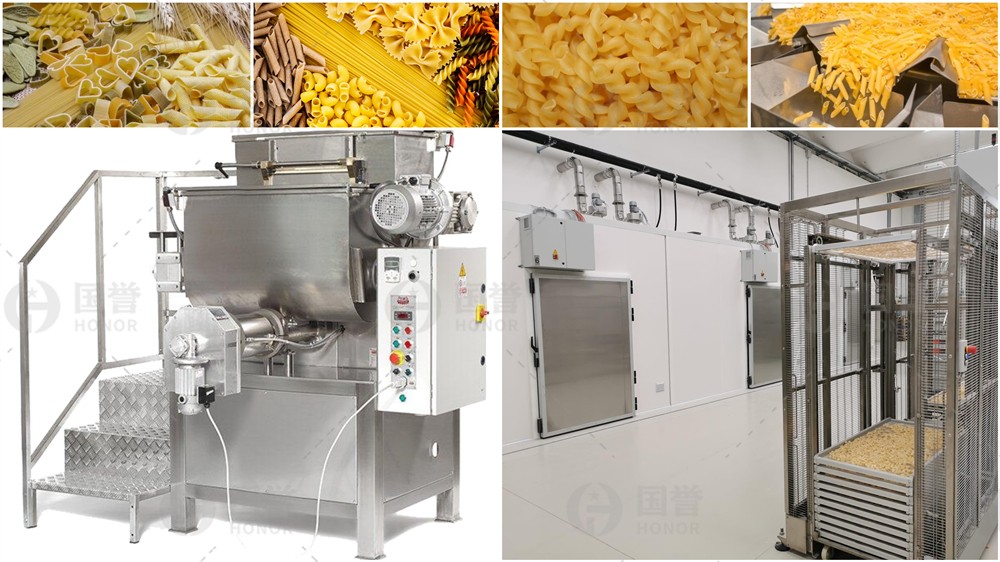
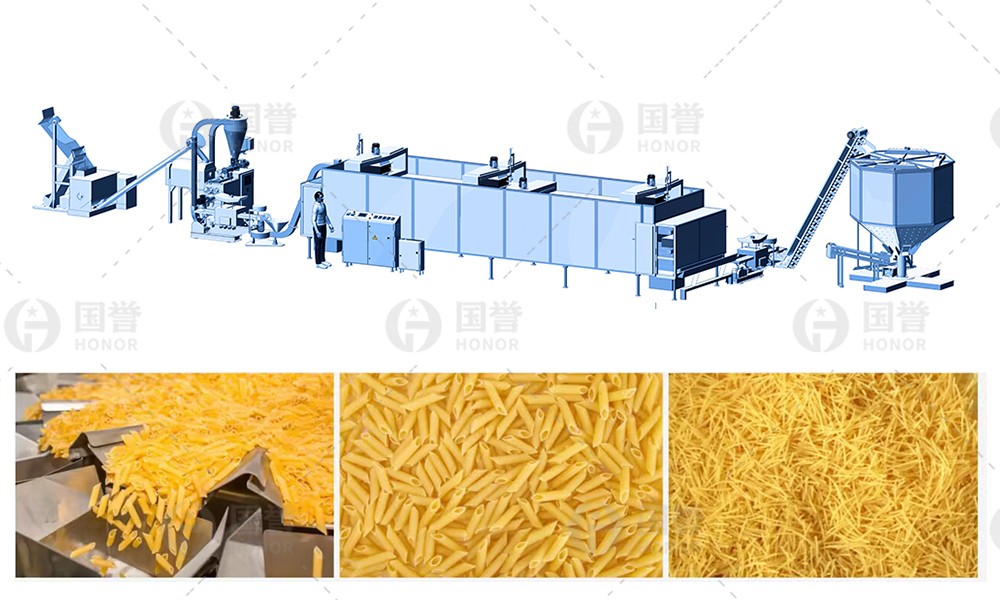
Hyper-Efficient Process Flow and Module Stacking: Within the ISO-standard container shell (typically 40 feet in length), the production sequence is orchestrated with symphonic precision in three-dimensional space, often utilizing vertical integration uncommon in traditional, spread-out plants. The process begins with integrated bulk flour storage or a precision hopper-feeder system, which supplies a high-shear vacuum mixer. The vacuum is critical, as it removes air bubbles from the dough, resulting in a denser, smoother extrudate with superior mechanical strength and a brighter final color. The homogeneous dough is then conveyed under consistent pressure to a computer-numerical-control (CNC) extrusion press.
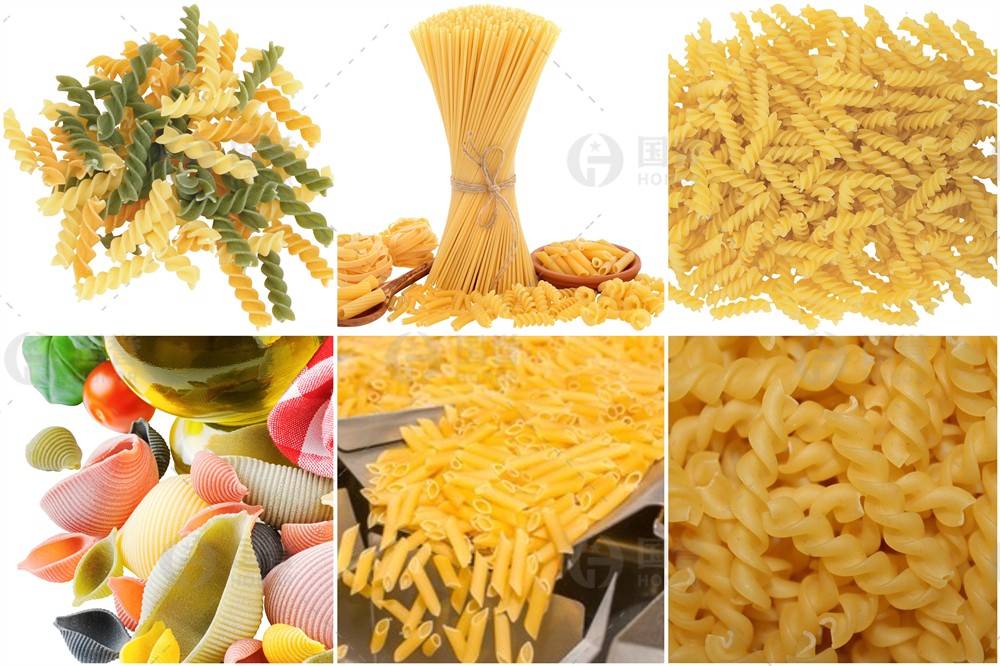
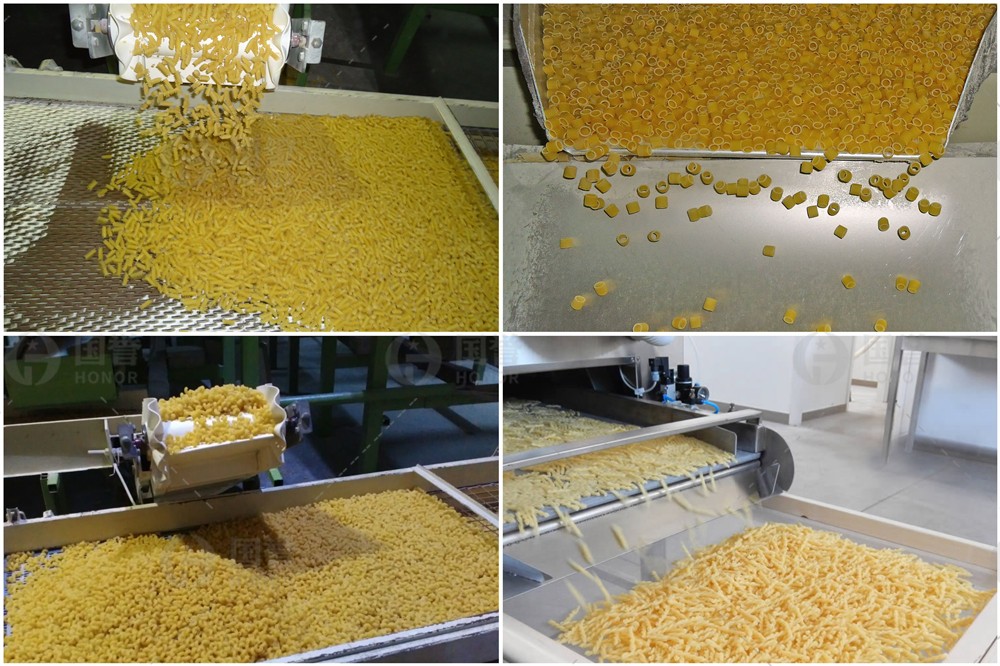
This is the heart of the shape-creation process. A quick-release die carriage system allows an operator to switch between dozens of pasta shapes—elbows, radiatori, farfalle, or custom-designed forms—in a matter of minutes, a task that could take hours of downtime and recalibration on a conventional line.
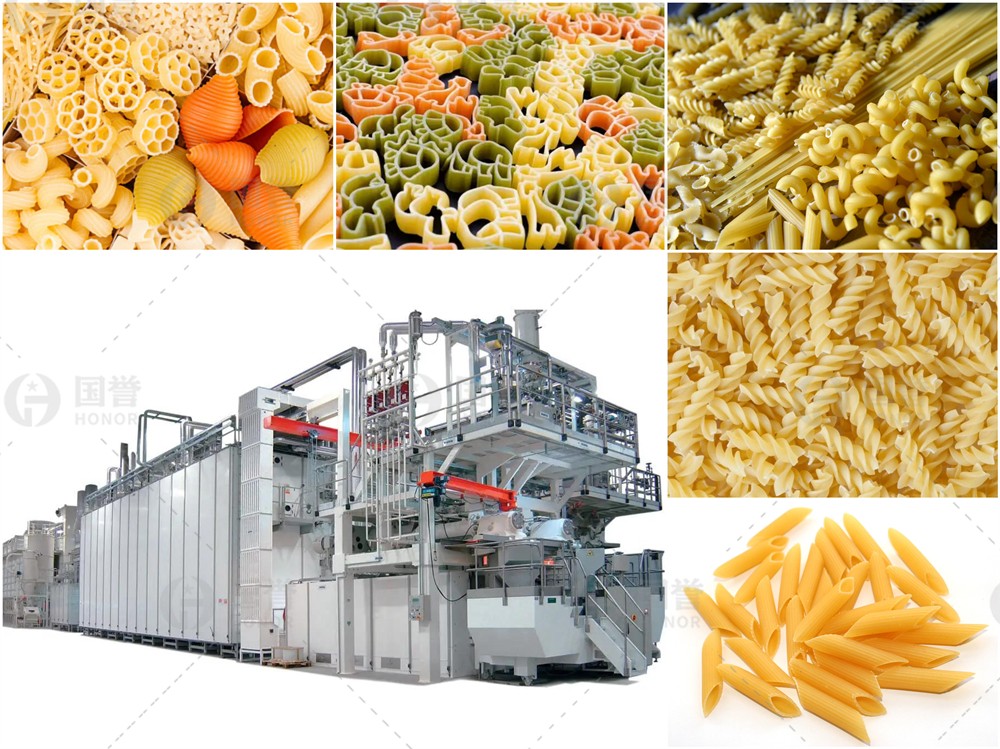
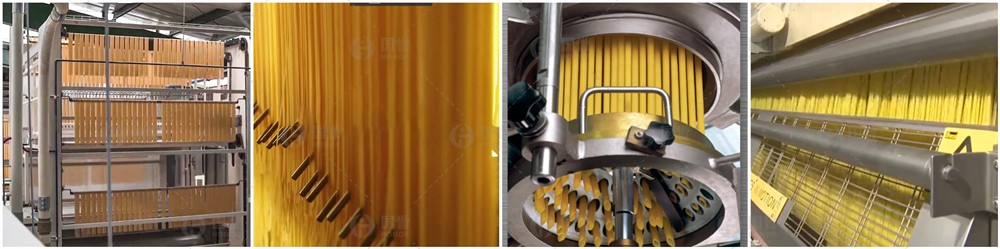
The Compact Drying Revolution: The most radical departure from tradition is the drying stage. Instead of a lengthy, gravity-fed tunnel requiring 20-40 hours, the containerized system employs a multi-zone, forced-air convection dryer with meticulously controlled microclimates. Using sophisticated algorithms, it manages a precise gradient of temperature, humidity, and airflow velocity across multiple stacked trays or a continuous belt loop.
This “intensive drying” approach can reduce drying time for short goods like macaroni to 4-8 hours, while actively managing starch gelatinization and protein network formation to guarantee the perfect bite and prevent checking (internal stress cracks). A subsequent rapid cooling zone stabilizes the product before it enters the final integrated packaging module, which can be configured for everything from 500g retail bags to 5kg food-service pouches.
3.Performance Breakthrough: Quantifying the Disproportionate Impact
The true measure of this innovation is found in its performance metrics, which consistently defy expectations based on its compact footprint. The system delivers not just comparable output, but does so with superior efficiencies.
Unprecedented Spatial and Operational Density: The contrast with a conventional setup is quantitatively stark. A traditional macaroni production line capable of 5 tons per day requires extensive floor space for machine placement, maintenance access, in-process inventory buffer zones, and personnel walkways. The containerized system eliminates these spatial inefficiencies through its integrated design.
Key Spatial and Agile Operational Metrics
|
Metric |
Conventional Pasta Production Line |
Containerized “Kitchen-in-a-Box” System |
|
Typical Floor Space Requirement |
180 - 250 m² |
30 - 40 m² (ISO Container Footprint) |
|
Average Installation & Commissioning Period |
4 - 8 months (incl. civils) |
10 - 20 business days (Plug-and-Play) |
|
Output Density (kg per m² per day) |
~20 - 30 kg/m²/day |
125 - 165 kg/m²/day (at 5t/day output) |
Advanced Energy and Resource Synergies: The enclosed, continuous nature of the system creates unique opportunities for energy optimization. Advanced models incorporate closed-loop heat recovery systems, where waste thermal energy from the high-temperature drying zones is captured by heat exchangers and redirected to pre-heat incoming air for the lower-temperature predrying stages or process water. This systemic approach, combined with high-efficiency, direct-drive motors and LED lighting, can yield a documented 18-25% reduction in specific energy consumption (kWh per kilogram of finished product) compared to a benchmarked traditional line. Water usage is also minimized through recirculation cooling systems for hydraulic units.
4.Technological Heart: Cyber-Physical Systems Ensuring Precision at Scale
The physical compactness and high performance are enabled and governed by a sophisticated cyber-physical system—a seamless integration of hardware with digital intelligence and data analytics.
Unified Control and Predictive Operation:
The system is managed by an industrial PC or a high-level PLC integrated with a comprehensive Human-Machine Interface (HMI)/SCADA system. This provides total visibility and control. Beyond mere monitoring, the system employs predictive algorithms. For example, by analyzing real-time flour moisture content (from an in-line sensor) and ambient humidity, it can automatically pre-adjust water injection rates and drying parameters before the batch even enters the dryer, ensuring consistent dough rheology. Recipe management is fully digitalized; an operator can load a “Fusilli” recipe that automatically sets all parameters from extrusion screw speed to dryer zone temperatures.
Closed-Loop Quality Assurance and Traceability:
Quality is controlled proactively, not just inspected post-production. In-line vision systems using high-resolution cameras and machine learning algorithms can inspect 100% of the product flow for defects in shape, color, or surface cracks at rates exceeding thousands of pieces per minute. Near-Infrared (NIR) spectroscopy probes provide continuous, non-destructive moisture analysis, creating a complete moisture profile for every batch.
All this data is logged and timestamped, providing full traceability. This level of control enables these systems to consistently achieve a First-Pass Yield (FPY) of over 99%, minimizing rework and waste and guaranteeing brand-quality consistency from the first to the last packet of the day.
5.Economic and Strategic Viability: Expanding the Market Ecosystem
The economic argument extends far beyond a simple comparison of machinery costs. It encompasses total cost of ownership, risk mitigation, and the unlocking of new business models and revenue streams.
Democratizing Access and Enabling Strategic Flexibility:
This technology fundamentally alters the risk profile of entering the pasta manufacturing sector. For a startup, the CapEx is often 40-50% lower than building a traditional facility for equivalent output, as it eliminates costs for special foundations, extensive electrical and plumbing runs, and large-scale climate control of a drying room.
For an established brand, it offers a low-risk tool for market expansion or product line testing without cannibalizing mainline production. Geopolitically, it allows countries or regions to rapidly establish import-substitution capabilities for staple foods, enhancing food security.
Comprehensive Total Cost of Ownership (TCO) Advantage:
The economic benefits are operational as well as capital. The streamlined, automated design reduces direct labor needs to typically 1-2 skilled technicians per shift, primarily for supervision, minor mechanical adjustments, and packaging material replenishment. Reduced factory overhead (lighting, HVAC for a smaller area) and dramatically lower waste (from near-perfect FPY) contribute to a superior operational expenditure (OpEx) profile. The modularity also future-proofs the investment; individual components (e.g., the packaging head) can be upgraded independently.
Illustrative Financial and Operational Analysis
|
Parameter |
Conventional Model (5t/day) |
Containerized "Kitchen-in-a-Box" Model |
|
Estimated Capital Investment |
$1.2M - $1.8M (facility + line) |
$650K - $850K (line + site prep) |
|
Key Operational Cost Driver: Labor |
5-6 FTE per shift |
1-2 FTE per shift |
|
Typical Product Changeover Time |
4 - 8 hours (major cleaning/re-tooling) |
30 - 90 minutes (automated purge & die change) |
|
Representative Payback Period |
5 - 7 years (high initial outlay) |
2 - 3.5 years (faster ROI) |
6.A Panorama of Transformative Applications: Redefining Where and Why Pasta is Made
The versatility of this platform allows it to address challenges and seize opportunities across a remarkably wide spectrum of the global food system, far exceeding the scope of a traditional pasta plant.
Diversifying Production Models and Strengthening Supply Chains:
Its applications are transformative across sectors:
Hyper-Local and Farm-Gate Production:
A wheat farmer or cooperative can integrate a unit to produce branded pasta directly from their own harvest, capturing full value-chain margins and offering a compelling “field-to-fork” story.
Private Label and Contract Manufacturing Agile Response:
A contract manufacturer can host multiple containerized units, each dedicated to a different client or specialty product (gluten-free, legume-based, organic), achieving flexibility impossible in a single monolithic plant.
Food Service and Institutional Sovereignty:
Large-scale caterers, cruise lines, university campuses, or government institutions can produce their own pasta, ensuring consistent quality, nutritional control, and insulation from supply chain volatility.
Humanitarian and Defense Logistics:
As a rapidly deployable asset, it can provide a sustained, dignified source of nutritious, culturally appropriate staple food in disaster relief scenarios or for military operations, transforming bulk flour donations into fresh, ready-to-eat product.
Contributing to a Circular and Resilient Food Economy:
The model inherently supports sustainability goals. Localized production slashes transportation-related emissions (Scope 3). Its efficiency reduces the energy and water intensity of pasta manufacturing. By enabling the economic use of diverse, locally-adapted grain varieties (e.g., ancient grains), it promotes agricultural biodiversity. The standardized container format itself simplifies end-of-life logistics, as the entire system can be relocated, repurposed, or refurbished with remarkable ease.
7.Conclusion: A Foundational Shift Towards a Distributed, Agile Food Manufacturing Future
The “Kitchen-in-a-Box” macaroni production line is more than an ingenious piece of machinery; it is a manifest proof-of-concept for the future of industrial manufacturing—a future that is distributed, digitally-integrated, and deeply responsive. It successfully decouples high-quality, efficient production from the traditional constraints of fixed, massive infrastructure, demonstrating that scale can be achieved through intensity and intelligence rather than mere physical volume.
Its impact is best summarized by a triad of transformative attributes: Accessibility, by dramatically lowering financial, temporal, and expertise barriers to industrial food production; Agility, providing unparalleled speed in deployment, product changeover, and market response; and Autonomy, through its self-regulating, data-driven operation that ensures quality and efficiency with minimal intervention. This model represents a decisive move from the rigid, centralized factory of the 20th century toward a network of agile, smart, and sustainable “micro-factories” for the 21st.
As global challenges—from climate volatility and supply chain fragility to growing consumer demands for transparency and localization—continue to intensify, the ability to efficiently and flexibly produce essential food items near their point of consumption will shift from a competitive advantage to a strategic priority. Containerized pasta production systems are at the forefront of this necessary transformation. They provide a scalable blueprint not only for pasta but also for a wide range of processed foods, heralding a new era where the factory itself becomes a mobile, intelligent asset, ready to provide nutrition according to the needs of communities and markets around the world.
8.Reference
1. Food Engineering Magazine
Website: https://www.foodengineeringmag.com
2. Food Processing
Website: https://www.foodprocessing.com
3. The International Food and Agribusiness Management Association (IFAMA)
Website: https://www.ifama.org
4. The National Pasta Association (NPA)
Website: https://www.nationalpasta.org
5. Pasta Technology
Website: https://www.pastatechnology.com